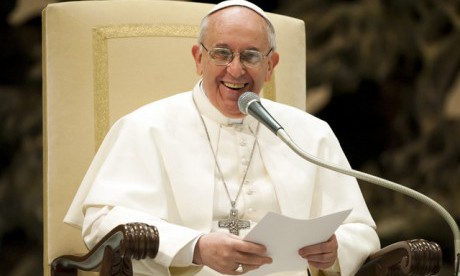
Is the Pope a conservative?
After the papal zingers which landed in Strasbourg last week, some — Nigel Farage, writing in the Catholic Herald, for instance — seem to think so.
Europe was ‘now a grandmother, no longer fertile and vibrant’, Pope Francis told a startled European Parliament, before saying that, to reconnect with ordinary people, the EU had to respect national values and traditions.
‘In order to progress towards the future we need the past, we need profound roots,’ he told the Council of Europe, a phrase redolent of Edmund Burke.
If some (including many Catholics) were surprised, it is understandable: most people still don’t know how Pope Francis thinks.
After he made what some took to be easygoing remarks about sexuality, people have assumed that he is just another liberal in the western mould.
This is a big mistake.
Jorge Mario Bergoglio may be, as I argue in my new biography, a ‘great reformer’ in the tradition of St Francis of Assisi — a gospel radical who recalls the church to its dependence on Christ and the Holy Spirit rather than power and status.
But in western cultural and political terms, he is a conservative who has spent his life in opposition to the abstract ideologies of the Enlightenment.
His background is firmly within the nationalist Catholic culture of Argentina that looks back to the Hapsburgs rather than the French revolution, and which flowered above all in the 1940s and 1950s, when Bergoglio was growing up in Buenos Aires.
It was the age of Colonel Perón and his wife Evita.
Articulating the ‘national’ and ‘popular’ and Catholic values of the immigrant classes, they inflicted a humiliating defeat on Argentina’s liberal establishment. Continue reading
Sources
- The Spectator
- Image: The Benedict Forum
Additional reading
News category: Features.