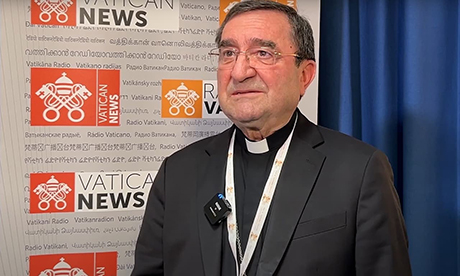
Lebanese Bishop Mounir Khairallah has expressed concern over political and economic interests hindering peace in the Middle East.
Speaking during a press briefing before the first anniversary of the deadly Hamas attack on Israel, Khairallah stressed that private agendas have overshadowed fundamental values such as human dignity and freedom.
Khairallah voiced frustration at the world’s silence in the face of ongoing hostilities between Israel and Lebanon.
He remarked, “The world is quiet, it doesn’t say anything… It even gives the green light for this violence because there are too many interests at the political and economic level”.
These private interests “have nothing to do with our Christian values” he added.
Two-state solution
Khairallah also spoke of the potential role Pope Francis and Vatican diplomacy could play in fostering peace. He referenced Lebanon’s historical significance as a model of religious coexistence.
Since 1948, the Holy See has consistently backed a two-state solution for the Israel-Palestine conflict.
“This resolution has always been rejected up until today by the State of Israel, by Israeli politicians” Khairallah said. He insisted that many Israeli citizens want peace and demonstrate for peace. However, “interests have the upper hand”.
The bishop also criticised Western nations, particularly the US, for not supporting those suffering in the Middle East.
“I think that this is a message from the synod that we are participating in this year: that the people who are oppressed should have the possibility, the right to decide concerning their future and their destiny” he said.
Peace through forgiveness
Drawing from personal experience, Khairallah highlighted the importance of forgiveness as a path to peace. He recounted how, at the age of five, his parents were killed in their home.
His aunt, a nun, taught him and his siblings to forgive their parents’ killers and to “pray for those who killed [their parents] and to seek to forgive throughout your lives”.
Khairallah believes that true peace can come only when individuals across all cultures and confessions work together, rather than being driven by political and economic agenda.
He acknowledged the difficulty of forgiveness but insisted it is not impossible, saying “We are capable of forgiving”.
Khairallah called on all parties to set aside hatred, vengeance and war, and urged the Church to lead by example, fostering dialogue and mutual respect.
Sources
Additional reading
News category: World.